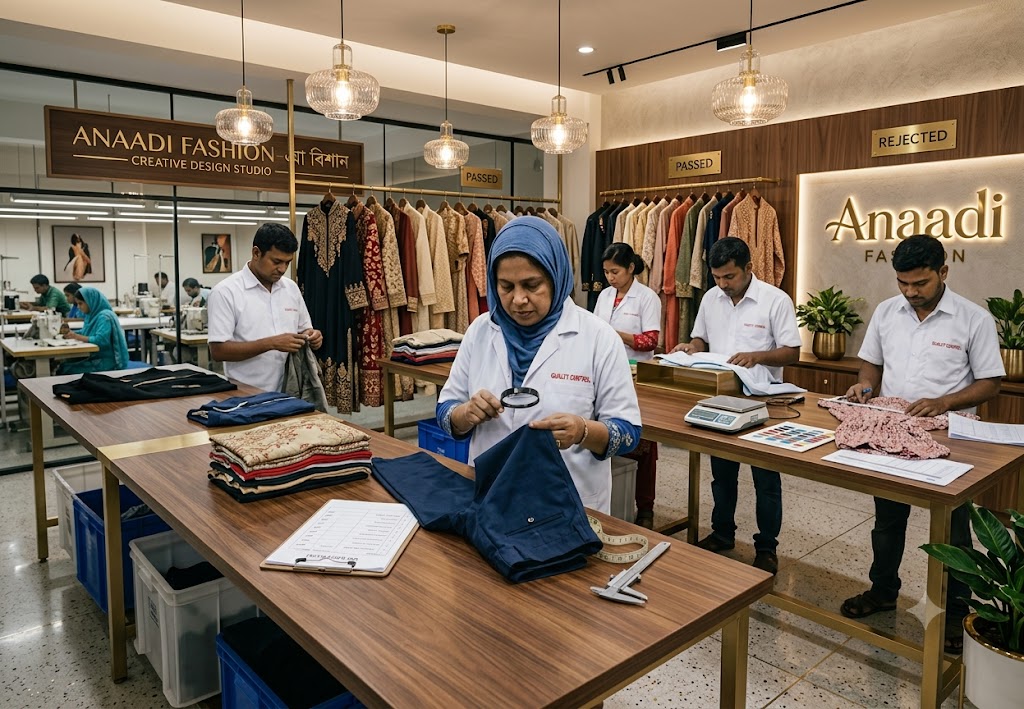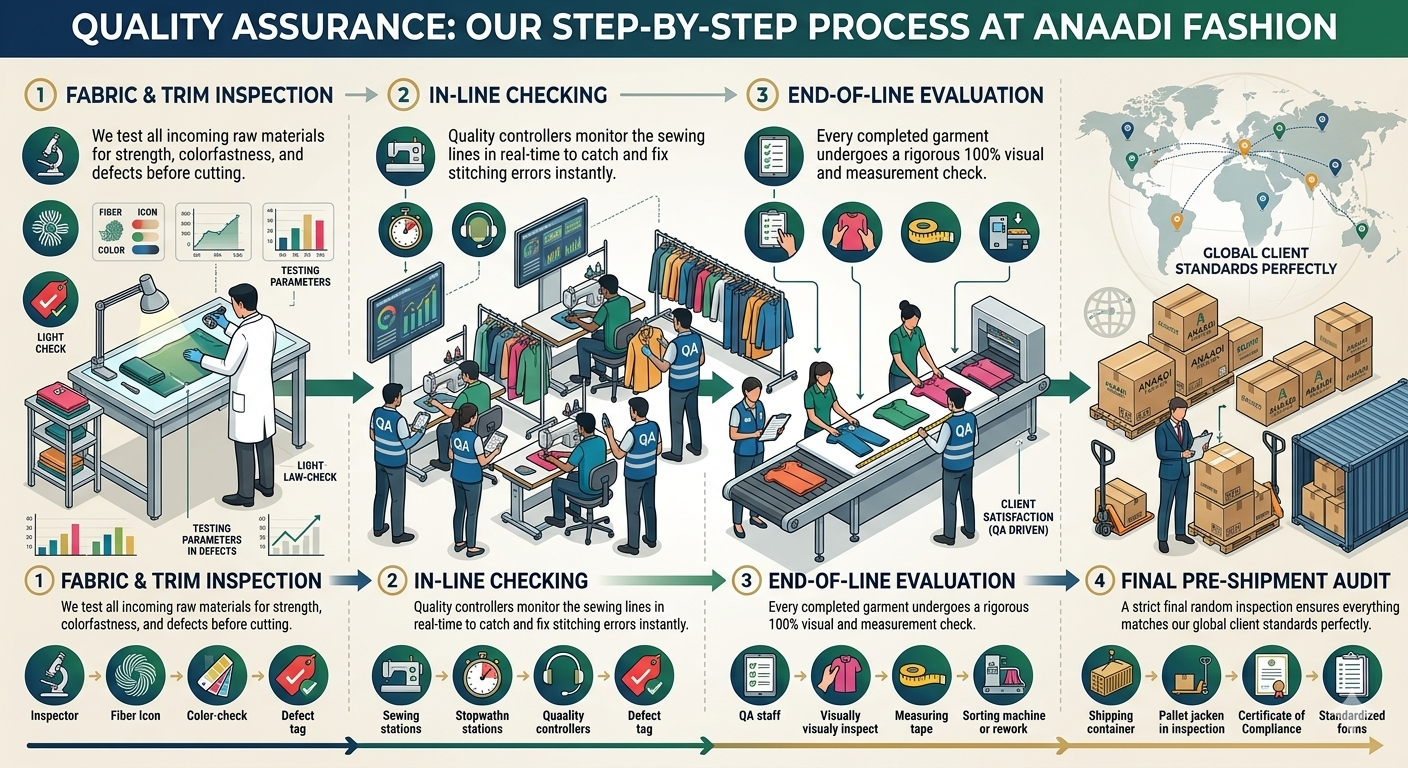

In garment sourcing, quality should never depend on assumptions or visual approval alone. For overseas buyers, the biggest concern is simple: whether the approved sample will actually match the bulk shipment arriving inside containers. At Anaadi Fashion, final inspection is not treated as a last-minute activity, it follows a structured quality system based on Acceptable Quality Limit (AQL) principles used across global manufacturing industries. Through planned sampling, technical inspections, defect classification, and shipment verification, our process helps ensure production stays aligned with buyer approvals. For example, if a buyer approves a women’s dress with a specific measurement tolerance or a kidswear collection with exact print placement, our inspection process checks these requirements before shipment approval. This approach reduces rework, lowers return risk, and creates more confidence in production outcomes. The concept of AQL is widely recognized across international inspection practices and quality management systems because it creates objective decision-making instead of random approval methods.
For many buyers, final inspection is often misunderstood.
It is not about opening a few cartons and giving approval.
It is a structured process designed to confirm that production quality remains consistent from development to shipment.
At Anaadi Fashion, we use AQL as a practical decision-making tool before container loading.
What AQL Means in Real Production
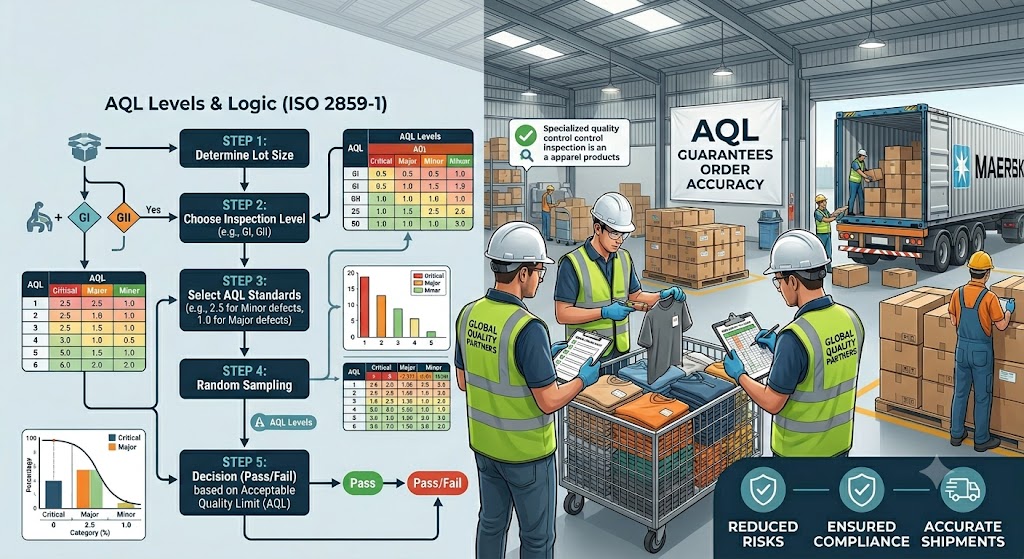
AQL, or Acceptable Quality Limit, is an internationally used sampling method that helps determine whether a shipment meets agreed quality standards.
The idea is practical:
Instead of checking every garment individually, a controlled number of pieces are selected and inspected.
The results are measured against defined acceptance levels.
This method is commonly used because inspecting 100% of production is rarely practical for commercial apparel orders.
For example:
If an order contains 30,000 cotton T-shirts, inspecting every piece would increase lead time and cost.
Instead, representative sampling provides a reliable view of production quality.
This allows buyers to make shipment decisions with greater confidence.
Industry inspection standards such as ANSI/ASQ Z1.4 and inspection methodologies used by international quality organizations follow this principle of statistical sampling.
How We Apply AQL at Anaadi Fashion
Our final inspection process begins only after earlier production controls are completed.
Before inspection starts, teams confirm:
- Approved samples
- Measurement specifications
- Packaging requirements
- Fabric approvals
- Buyer comments
Only then does final inspection begin.
Step 1: Random Carton Selection
Inspection cartons are selected from different areas of finished production.
This prevents selective presentation and creates more representative inspection results.
Step 2: Technical Product Checks
Each selected garment goes through structured evaluation including:
- Measurement verification
- Fabric appearance
- Stitch quality
- Label placement
- Trims and accessories
- Finishing standards
For example:
If a buyer approved a relaxed-fit women’s dress with ±1 cm tolerance, measurements are verified against approved specifications.
If a children’s garment required centered print placement and wash consistency, those details are reviewed before approval.
Step 3: Defect Classification
Inspection findings are categorized to support objective decisions.
Critical defects:
Issues that make products unsafe or unusable.
Major defects:
Issues affecting appearance or performance.
Minor defects:
Small appearance variations that do not affect usability.
This classification helps teams prioritize quality risks correctly.
Why This Process Matters for Buyers
Quality issues often become expensive after shipment.
Incorrect measurements may lead to returns.
Wrong labels may create retail issues.
Shade variation can affect entire store displays.
By applying structured AQL inspection before loading containers, these risks are reduced before goods leave production facilities.
For overseas buyers, this creates:
- More predictable shipments
- Better consistency
- Lower correction costs
- Higher confidence in approvals
Turning Approval into Shipment Accuracy
At Anaadi Fashion, final inspection is not treated as paperwork.
It acts as proof that production remained aligned throughout manufacturing.
Our objective is straightforward:
What buyers approve during development should be what reaches stores.
By combining structured sampling, technical inspection, and measurable acceptance standards, we help convert approvals into shipment accuracy.
Because in garment sourcing, quality should not depend on assumptions—it should be verified before containers are sealed.
Final Thoughts
Overseas buyers do not want surprises after containers arrive.
They want confidence that approved products will reach stores exactly as expected.
That confidence comes from structure, process, and measurable inspection.
Through disciplined AQL inspection before container loading, Anaadi Fashion helps ensure that quality decisions are based on data—not assumptions.
Because final inspection should never be arbitrary.
It should prove that what buyers approve is exactly what gets shipped.
References:
ANSI/ASQ Z1.4 – Sampling Procedures and Tables for Inspection by Attributes (ASQ) — Internationally recognized sampling standard used for AQL-based acceptance inspection and lot evaluation.
ASQ Guide: Attribute Sampling Plans & ANSI Z1.4 Explained — Practical explanation of acceptance sampling methods and how AQL inspection is applied in manufacturing environments.
ANSI Standards Store – ANSI/ASQ Z1.4 Sampling Procedures Package — Official documentation covering inspection procedures and acceptance sampling frameworks.